
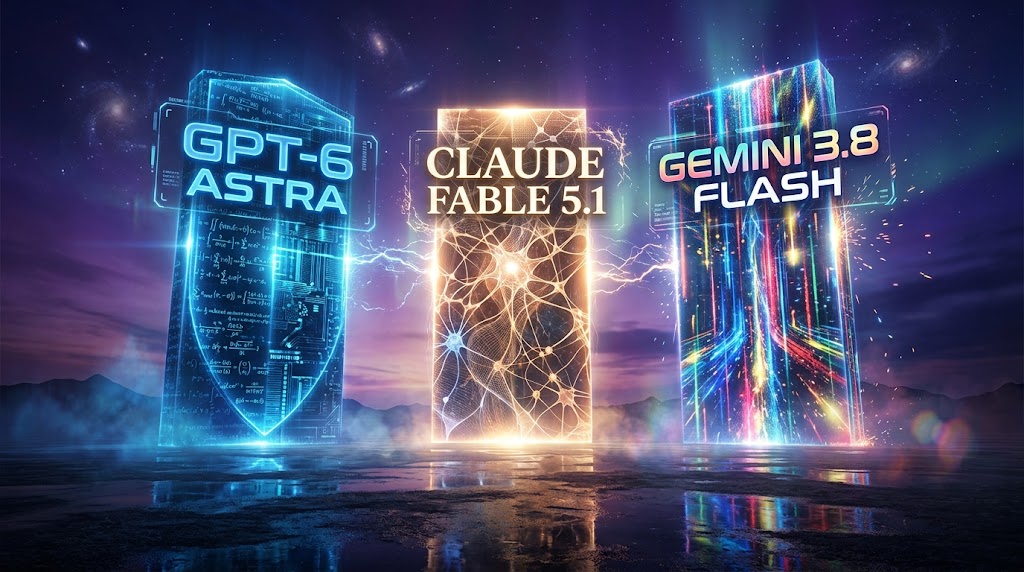
Quick Answer: Between September 1 and September 3, 2026, OpenAI, Anthropic, Google, and Meta launched four major AI model updates within 72 hours — the most compressed flagship release cycle in AI history. Claude Fable 5.1 leads overall intelligence and coding. GPT-6 Astra leads computer use and ARC-AGI-3 benchmarks. Gemini 3.8 Flash is 13 times cheaper than GPT-6 Astra and 3 times faster. For most users, the right choice depends entirely on your budget and use case — not which model is “best” on paper.
The week of September 1, 2026 will be remembered as the moment the AI model war went from a quarterly competition to a real-time battle measured in hours.
On September 1, Anthropic launched Claude Fable 5.1 and its restricted-access sibling Claude Mythos 5.1. On September 2, Google DeepMind shipped Gemini 3.8 Flash — its third Flash model release in just six weeks. On September 3, OpenAI closed the window with GPT-6 Astra, a model it had actually delayed a month earlier over safety concerns. And sandwiched between all three, Meta quietly released Muse Spark 1.3 on September 2 with an open-weights roadmap that changed the cost calculation for every developer in the field.
Four flagship AI models from four of the world’s most powerful technology companies — within 72 hours.
GPT-6 Astra vs Claude Fable 5.1 vs Gemini 3.8 Flash is the single most searched AI comparison query on the internet right now in September 2026 — and for good reason. These are not incremental updates. They represent genuinely different approaches to AI capability, pricing, and use-case specialization that affect every person, business, and developer who uses AI tools daily.
This guide cuts through the benchmarks, the marketing claims, and the noise. No developer jargon. No vendor bias. Just the clearest, most honest breakdown of what each model actually does, what it costs, who it is for, and — most importantly — which one you should be using right now.
Why This Week Changed the AI Industry Forever
To understand why this release week matters so much, you need to understand what happened to AI pricing in 72 hours.
Before September 1, 2026, the frontier AI model landscape had a clear pricing structure. Premium frontier models cost between $10 and $50 per million tokens. Mid-range models sat around $3 to $5. Budget models came in under $1. The tiers were distinct and the choice between them involved real trade-offs.
After September 3, those tiers collapsed into each other in ways nobody predicted.
Gemini 3.8 Flash landed at $0.75 per million input tokens — a price previously associated with mid-range models — while delivering benchmark scores that rival models costing ten times as much. Claude Fable 5.1 maintained its $10 per million input pricing but simultaneously slashed cached input costs by 75%, from $1.00 to $0.25 per million tokens, transforming the economics for any application that reuses context repeatedly.
The number that summarizes the entire situation: running the same 10-million-token workload across the models available in September 2026 spans a 107-times cost range — from $1.68 on DeepSeek V4 Flash to $180 on GPT-6 Astra or Claude Fable 5.1. That range is not a spectrum of quality. It is a spectrum of specialization. Knowing where your use case falls on that spectrum is the most important AI decision you can make right now.
GPT-6 Astra vs Claude Fable 5.1 vs Gemini 3.8 Flash: Full Specifications
Before the analysis, here are the verified numbers as of September 21, 2026:
| Specification | GPT-6 Astra | Claude Fable 5.1 | Gemini 3.8 Flash |
|---|---|---|---|
| Launch Date | September 3, 2026 | September 1, 2026 | September 2, 2026 |
| Context Window | 1.05 million tokens | 1 million tokens | 1 million tokens |
| Max Output | 128K tokens | 128K tokens | 64K tokens |
| Input Price | $10 per million | $10 per million | $0.75 per million |
| Output Price | $50 per million | $50 per million | $3.75 per million |
| Cached Input Price | Not published | $0.25 per million | Not published |
| Intelligence Index | 61 | 66 | 59 |
| Coding Agent Index | 67.0 | 70.4 | 61.1 |
| ARC-AGI-3 | 62.7% | 30.2% | Competitive |
| Speed | Standard | Standard | 305 tokens/second |
| Computer Use | Yes — primary feature | Strong | Limited |
| Best For | Computer use, math, science | Coding, intelligence, writing | High-volume, cost-sensitive work |
GPT-6 Astra: OpenAI’s Bet on Computer Use and Scientific Reasoning
GPT-6 Astra is the first model in OpenAI’s GPT-6 generation, and it represents a deliberate strategic choice: instead of competing on every benchmark simultaneously, GPT-6 Astra is built specifically to operate computers, solve frontier mathematics, and handle professional scientific work at a level no previous public model has achieved.
OpenAI calls it the world’s most intelligent and aligned model — a claim that the ARC-AGI-3 benchmark supports more convincingly than almost any other metric. GPT-6 Astra scores 62.7% on ARC-AGI-3 — more than double Claude Opus 5’s 30.2% on the same test. On FrontierMath Tier 4, it scores 97.6%. On OSWorld 2.0 — the benchmark for operating computers across real software environments — it scores 72.6%.
These numbers represent genuine capability advances for very specific, very demanding use cases. If your work involves operating software autonomously across complex environments, solving research-grade mathematical problems, or processing professional scientific documents — GPT-6 Astra is in a different league from any previous public model.
But here is the honest counterbalance: on the Artificial Analysis Intelligence Index — the broadest, most composite benchmark of overall model capability — GPT-6 Astra scores 61. Claude Fable 5.1 scores 66. For general-purpose work that is not specifically about computer use or frontier mathematics, GPT-6 Astra is not the top performer despite its frontier positioning.
The price is also the highest in the consumer-facing AI market: $10 per million input tokens and $50 per million output tokens. Running GPT-6 Astra at scale costs approximately 13 times more than Gemini 3.8 Flash for the same token volume.
GPT-6 Astra is the right choice if: You need autonomous computer use across real software. You work in frontier mathematics or scientific research. You need the longest single-document context window at 1.05 million tokens. Cost is secondary to maximum capability for high-stakes, complex work.
GPT-6 Astra is not the right choice if: You need cost-efficient high-volume processing. Your work is primarily writing, coding, or creative tasks. You are comparing price-to-performance rather than absolute performance ceiling.
Claude Fable 5.1: The Overall Capability Leader in September 2026
Claude Fable 5.1 is the model that most independent benchmarks and practitioners are treating as the overall capability leader in September 2026 — and the data supports that assessment across the broadest range of tasks.
On the Artificial Analysis Intelligence Index, Fable 5.1 scores 66 — five points ahead of GPT-6 Astra and seven points ahead of Gemini 3.8 Flash. On the Coding Agent Index, it scores 70.4 — ahead of GPT-6 Astra at 67.0 and Gemini 3.8 Flash at 61.1. On Terminal-Bench and AutomationBench, Fable 5.1 shows significant gains over its predecessor Fable 5. On long agentic coding tasks — the extended, multi-step software development work that is the defining use case of AI-assisted development in 2026 — Claude Fable 5.1 leads its direct competitors.
The September 1 pricing change deserves particular attention. Anthropic cut cached input pricing from $1.00 to $0.25 per million tokens — a 75% reduction. For any application that repeatedly reuses context — a customer service system with a persistent knowledge base, a coding assistant with a persistent codebase, a document analysis tool with fixed reference materials — this price cut fundamentally changes the economic case for Fable 5.1. Applications that were previously marginal on cost become viable overnight.
Fable 5.1 also comes with an important institutional context. The Mythos 5.1 model — released simultaneously and sharing the same underlying weights as Fable 5.1 — is Anthropic’s restricted cybersecurity and life sciences research model deployed through Project Glasswing. The public and restricted models sharing the same base architecture means Fable 5.1 represents Anthropic’s absolute frontier capability as of September 2026, with safety measures applied on top rather than capability compromised.
Claude Fable 5.1 also pairs a public flagship with a restricted dangerous-capability twin — a pattern that has become routine across all three major labs in barely a year and reflects the industry’s growing recognition that frontier AI capabilities require differentiated access controls.
Claude Fable 5.1 is the right choice if: You need the highest overall capability across writing, coding, analysis, and reasoning. Your work involves extended agentic coding sessions or complex multi-step professional tasks. You use AI repeatedly with similar context — the cached pricing makes it economically competitive. You want the model with the strongest verified, independently tested benchmark results as of September 2026.
Claude Fable 5.1 is not the right choice if: You specifically need computer use for desktop software — GPT-6 Astra leads here. You need the cheapest option for high-volume simple tasks — Gemini 3.8 Flash is thirteen times cheaper. You need cutting-edge ARC-AGI-3 scores — GPT-6 Astra leads on this specific benchmark.
Gemini 3.8 Flash: The Speed and Price Revolution
Gemini 3.8 Flash is the most disruptive model of September 2026 — not because it leads every benchmark, but because it delivers near-frontier performance at a price point that makes everything else look expensive.
At $0.75 per million input tokens and $3.75 per million output tokens, Gemini 3.8 Flash is priced lower than some models that were considered mid-range just six months ago. Yet it achieves an Intelligence Index score of 59 — competitive with models costing ten times as much — and an output throughput of 305 tokens per second, making it the fastest of the three major releases this week.
Google’s positioning is clear: Gemini 3.8 Flash is the primary general-purpose workhorse model for applications where volume matters, latency matters, and cost matters. It is the third Flash model release in six weeks — a release cadence that signals Google’s strategic commitment to winning the high-volume, cost-sensitive market segment even as its frontier models compete at the top end.
The benchmark picture is nuanced in important ways. Google’s own six-model comparison table shows Gemini 3.8 Flash leading Claude Opus 5 and GPT-5.6 Sol on Vals Finance Agent v2 and Terminal-Bench 2.1, while trailing both on Terminal-Bench 4.0 and OSWorld-2.0. This is the honest picture of a model that punches above its weight class in specific domains while accepting trade-offs in others.
One critical detail every user needs to know: Gemini 3.8 Flash’s introductory pricing of $0.75 per million input tokens is valid through December 31, 2026. After that, pricing is expected to increase significantly — potentially doubling. Any cost calculation built on current Gemini 3.8 Flash pricing needs to account for this scheduled change before committing production infrastructure to it.
Gemini 3.8 Flash is the right choice if: You need high-volume AI processing where cost efficiency is the primary constraint. Your application requires maximum response speed at 305 tokens per second. You are building products for users where cost per interaction determines profitability. You want competitive frontier performance at a fraction of the premium model price.
Gemini 3.8 Flash is not the right choice if: You need maximum overall intelligence — Fable 5.1 leads. You need computer use capabilities — GPT-6 Astra leads. You are planning long-term cost commitments — the January 2027 price increase changes the economics significantly.
The Real-World Performance: What Practitioners Are Actually Seeing
Benchmark numbers tell you what the labs measured. What practitioners are experiencing in actual production work is the honest test of each model — and the early September 2026 reports from developers, writers, and business users reveal a more nuanced picture.
Coding and Software Development
Claude Fable 5.1 leads in extended agentic coding — the multi-file, multi-session software development work that defines real engineering projects. Claude Opus 5, which has had two months of production mileage since its July launch, remains the choice of many engineering teams for coding work with an Arena ELO of 1522. GPT-6 Astra uses approximately 65% fewer output tokens than Opus 5 at maximum reasoning settings — a significant efficiency gain for applications charged by output volume. Gemini 3.8 Flash surprises developers with DeepSWE benchmark results that challenge models priced much higher for routine coding tasks.
Writing and Creative Work
Claude Fable 5.1 maintains the quality edge that the Claude family has built for writing-intensive applications. Its nuanced handling of tone, context retention across long documents, and instruction-following on complex stylistic requirements makes it the choice for professional writing applications where output quality directly affects the final product.
Research and Analysis
GPT-6 Astra’s ARC-AGI-3 score of 62.7% and FrontierMath performance represent genuine advances for research-grade analytical work. For users whose work involves systematic reasoning across complex, novel problems — not just pattern matching against training data — Astra’s reasoning architecture shows measurable advantages.
Customer-Facing Applications and High-Volume Deployments
Gemini 3.8 Flash dominates this category. At $0.58 average cost per task and 305 tokens per second throughput, it makes AI-powered customer interactions economically viable at scales that were prohibitive at frontier model prices. The speed advantage is particularly meaningful for real-time conversational applications where latency directly affects user experience.
How to Choose: The Decision Framework for September 2026
Stop trying to find one universal winner. The right answer for you is determined by four questions:
Question 1: What is your primary use case?
- Computer use and autonomous software operation → GPT-6 Astra
- Coding, extended agent tasks, complex writing → Claude Fable 5.1
- High-volume general tasks, fast responses → Gemini 3.8 Flash
Question 2: What is your cost constraint?
- Cost is secondary to maximum capability → GPT-6 Astra or Fable 5.1
- Cost efficiency is critical for viability → Gemini 3.8 Flash
- You reuse large amounts of context repeatedly → Fable 5.1 (cached pricing advantage)
Question 3: How long is your planning horizon?
- Short-term project until end of 2026 → Gemini 3.8 Flash is excellent value now
- Long-term production commitment → Account for Gemini Flash price increase in January 2027
- Enterprise commitment with stable pricing needs → Fable 5.1 or GPT-6 Astra
Question 4: Do you need the absolute performance ceiling?
- Yes, you need the best possible output quality → Claude Fable 5.1 (Intelligence Index 66)
- Yes, you specifically need reasoning/math frontier → GPT-6 Astra (ARC-AGI-3 62.7%)
- No, “very good” is sufficient and cost matters → Gemini 3.8 Flash
The smartest approach in September 2026 — confirmed by multiple practitioners who have tested all three — is to run your own twenty real tasks from your actual work across the models rather than relying on any benchmark. The model that produces the best output for your specific tasks, at a cost your use case can support, is the right model regardless of leaderboard position.
The Bigger Picture: What This Week Tells Us About AI in 2026
The 72-hour release window of September 1-3, 2026 reveals something important about where the AI industry stands that goes beyond which model wins which benchmark.
The intelligence gap between top models has collapsed to almost nothing. Artificial Analysis Intelligence Index scores of 66, 61, and 59 for Fable 5.1, GPT-6 Astra, and Gemini 3.8 Flash respectively represent a maximum gap of 7 points across models from three different companies with fundamentally different architectures. Two years ago, the gap between frontier models and mid-range models was enormous. Today, the gap between the absolute frontier and a $0.75 model is 7 points on a composite intelligence score.
The price war is the most consequential development. When Gemini 3.8 Flash delivers competitive frontier intelligence at $0.75 per million input tokens, it changes the economic foundation of AI product development globally. Applications that were previously uneconomical become viable. Businesses in markets where AI costs had been prohibitive — including in South Asia, Africa, and Southeast Asia — can now access near-frontier AI capability at prices that make product development feasible.
The specialization era has arrived. Rather than one model doing everything best, September 2026 shows three major models each clearly dominant in different categories: computer use and math reasoning, overall intelligence and coding, and speed and cost efficiency. This specialization will accelerate. The era of one model winning every category is over.
Safety restrictions are becoming routine at the frontier. All three major labs now pair their public flagship model with a restricted dangerous-capability twin — GPT-6 Astra and the delayed safety variant, Fable 5.1 and Mythos 5.1, Gemini 3.8 Flash and Gemini 3.8 Flash Cyber. This pattern, which emerged in barely a year, reflects the industry’s systematic recognition that the most capable models require differentiated access for different risk levels.
What This Means for Everyday AI Users
If you use ChatGPT, Claude, or Gemini daily — here is what this week’s releases mean for your actual experience.
ChatGPT users will have access to GPT-6 Astra on ChatGPT Pro plans. For everyday tasks — writing help, research, conversation — the upgrade from GPT-5.6 brings improvements in reasoning and document handling. For most routine ChatGPT use cases, the difference in daily experience will be real but not dramatic. For computer use and highly complex reasoning tasks, the improvement is substantial.
Claude users are in an interesting position. Claude Fable 5.1 is positioned as a premium model, not a consumer default. Claude Sonnet 5 remains the default model on free and Pro tiers, with Fable 5.1 available as an upgrade for high-intensity work. The 75% reduction in cached input pricing benefits developers and heavy users far more than casual users. The quality of outputs from Fable 5.1 on demanding tasks — detailed analysis, long creative work, complex coding — is meaningfully better than any previous version.
Gemini users get Gemini 3.8 Flash as a speed and capability upgrade within the Gemini app. The improvements in response speed — 305 tokens per second — make real-time conversation noticeably more fluid. The competitive benchmark performance means users get near-frontier AI quality at no additional cost within Google’s current pricing structure.
New users choosing a platform face the most interesting decision. If you are starting with AI tools for the first time in September 2026, the honest recommendation is to begin with whichever platform integrates with the tools you already use. If you live in Google Workspace, Gemini is the natural fit. If you primarily write, analyze, and code, Claude’s interface is worth trying specifically. If you need AI that can operate your computer software, ChatGPT with GPT-6 Astra is the platform to evaluate.
The GEO Reality: How AI Model Releases Are Reshaping Global Access
The September 2026 model wave has a geographic dimension that rarely gets the attention it deserves.
Gemini 3.8 Flash’s $0.75 per million input token pricing is available globally through Google AI Studio and the Gemini API. For developers and businesses in Pakistan, India, Bangladesh, and across Southeast Asia — markets where previous frontier model pricing made serious AI product development economically marginal — this pricing represents a genuine access breakthrough.
A developer in Lahore or Dhaka building an AI-powered product in September 2026 can access near-frontier AI capability at approximately the same economic terms as a developer in San Francisco. This price parity, which simply did not exist at the frontier level two years ago, is one of the most significant technology access shifts in recent digital history.
Claude Fable 5.1’s 75% reduction in cached input pricing has a similar democratizing effect for applications that require persistent context — particularly educational tools, customer service systems, and document processing applications that benefit from maintaining large knowledge bases across conversations. These use cases are particularly relevant for markets where document-heavy professional services, government interactions, and educational access are primary AI use cases.
GPT-6 Astra’s computer use capabilities, while currently priced at the high end of the market, represent a capability that will eventually reach more accessible price points — and when it does, the ability to have AI operate software autonomously will be transformative for knowledge workers across every market globally.
Frequently Asked Questions
Which is the best AI model released in September 2026? Claude Fable 5.1 leads overall intelligence with an Artificial Analysis Intelligence Index of 66. GPT-6 Astra leads on ARC-AGI-3 at 62.7% and computer use. Gemini 3.8 Flash leads on speed and cost efficiency at $0.75 per million input tokens. There is no single winner — the best model depends entirely on your use case and cost requirements.
How much does GPT-6 Astra cost? GPT-6 Astra costs $10 per million input tokens and $50 per million output tokens. This makes it the most expensive of the September 2026 releases and approximately 13 times more expensive than Gemini 3.8 Flash for the same token volume.
Is Claude Fable 5.1 better than GPT-6 Astra? Fable 5.1 leads on overall intelligence (66 vs 61 on the Intelligence Index) and coding (70.4 vs 67.0 on Coding Agent Index). GPT-6 Astra leads on ARC-AGI-3 (62.7% vs 30.2%) and computer use capabilities. For most everyday tasks, Fable 5.1 produces better results. For frontier math and computer use specifically, GPT-6 Astra has the advantage.
Why is Gemini 3.8 Flash so much cheaper than the others? Gemini 3.8 Flash is priced at $0.75 per million input tokens as an introductory rate valid through December 31, 2026, after which pricing is expected to increase significantly. Google’s strategy is capturing market share in the high-volume, cost-sensitive segment where speed and price matter more than the absolute intelligence ceiling.
What is Claude Mythos 5.1 and why is it different from Fable 5.1? Claude Mythos 5.1 and Fable 5.1 share the same underlying model weights. Mythos 5.1 is a restricted-access version with certain safety safeguards removed for vetted cybersecurity and life-sciences research organizations through Anthropic’s Project Glasswing. Fable 5.1 is the public version with full safety measures in place.
Should I switch AI tools after this week’s releases? Only if your current tool has a specific capability gap that one of the new models fills. The practical performance differences between these models for typical daily tasks — writing, research, basic coding, conversation — are real but not dramatic enough to justify switching costs for most users. If you have a specific high-value use case where one model clearly leads, a targeted upgrade makes sense.
Is GPT-6 available for free? GPT-6 Astra is available on ChatGPT Pro plans and through the OpenAI API at $10 per million input tokens. It is not available on the ChatGPT free tier, which uses GPT-5.6 Luna as its default model.
Which AI model is best for content creators and bloggers? Claude Fable 5.1 leads for content creation, long-form writing, and tasks requiring nuanced tone and instruction following. For high-volume content generation where cost matters, Gemini 3.8 Flash delivers competitive quality at a fraction of the price.
The AI model landscape changed permanently this week. AI Pilot Guide tracks every development, release, and benchmark in the AI space so you never fall behind the tools that are reshaping how the world works. Explore the full library for more guides, comparisons, and strategies for navigating the AI revolution in 2026.